Labels

Showing posts with label Points of Interest. Show all posts

Wednesday, February 25, 2015

Santa Barbara holds a special place in my heart, as it is home to my alma mater, U.C.S.B.  Several years ago, when my boys were choosing their college, I toured the campus and hardly recognized where I spent so much of my time when I was their age.  The college of engineering has completely changed with the buildings I called my second home, having been replaced.  Come on now...it hadn't been that long.  


Studying was my priority back then.  I didn't spend much time on the beach, so every chance I get now, I'm there making up for it.


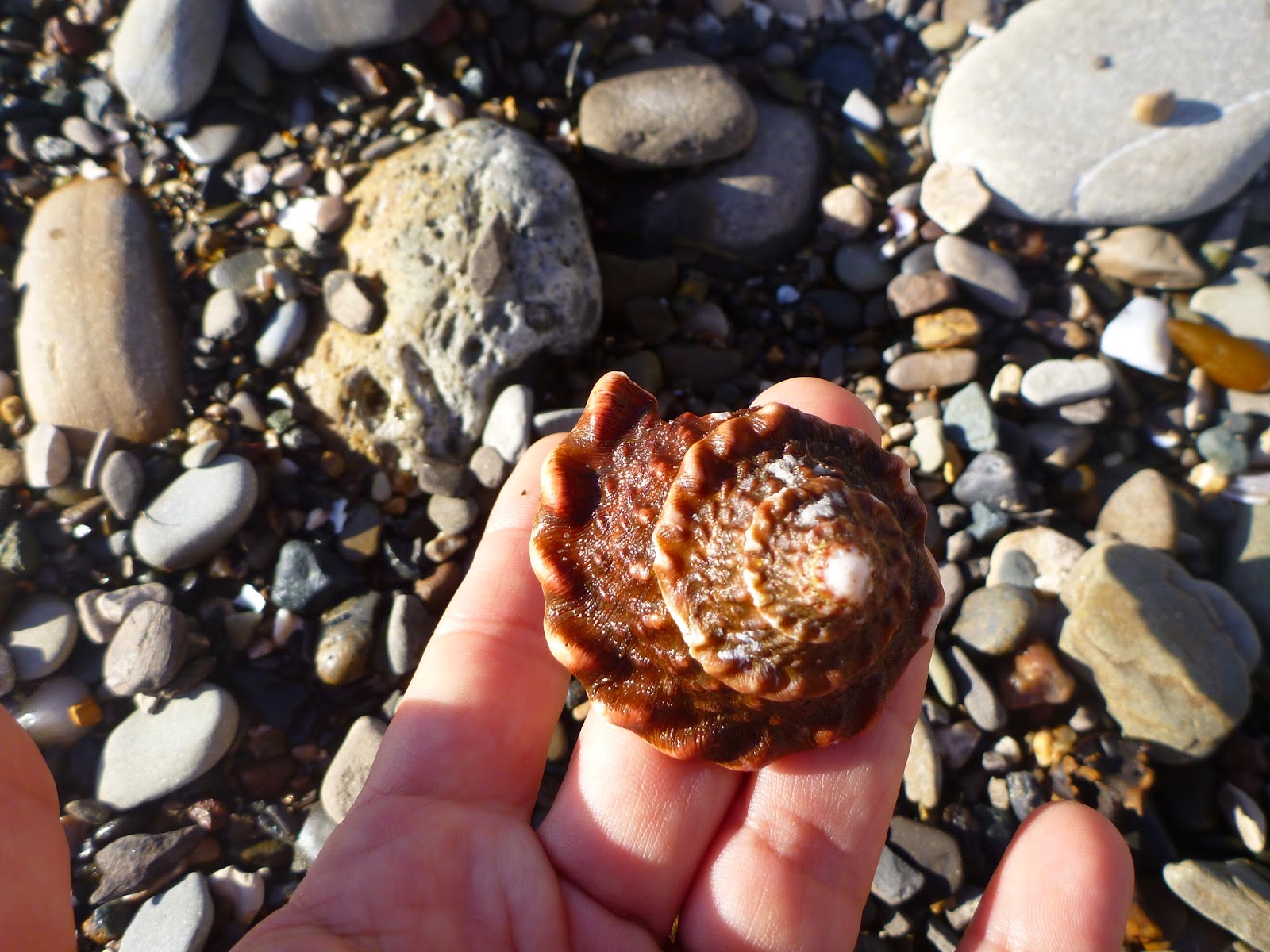
What time I did spend with the sand, was always shared with the tar, presumably generated from the off shore oil derricks.  This was common to see on the beach and we would involuntarily takes it with us (bare feet, flip flops, and tennies) back to the dorms.  Today, I see none of it around.  Huh... the mussels do seem larger too.
On days like today, I remember why it is I pay almost 10% in local sales tax, assume the risk from imminent earthquakes, drive miles around high population densities, and have to/can't water my lawn.  It's drop dead gorgeous. 


It's easy to let time piddle away here in the Golden State,  named not only for the discovery of gold, but also for these golden coastal sunsets.


Friday, February 20, 2015

Even the non-caffeinated among us will recognize this logo.  It's a popular beverage for over worked college students as well as others needing a bit more zip in their step; Monster Energy Drinks.  I reference it as a toxic waste dump with my kids, but they just laugh, as they love em.


Monster Energy is a major sponsor for the AMA Supercross, a nationwide sporting event televised on FOX Sports, involving off road motorcycles racing on an artificially made dirt track with jumps, tight turns, and whoops.


Typically my family votes for riding the bikes over watching them being ridden, but Petco Park is a downtown icon. What better way of experiencing it than with truck loads of dirt filling the infield?

Ah, but not so fast.  First there's the Pit Party.  Your ticket in? ...an empty Monster can of course.  Kid's have plenty of those, so in we go.

In addition to receiving a can of 
your favorite Monster Energy Drink, including ones not yet released, there are cool bikes to see, Monster merchandise for sale, and a chance to view the bikes being worked on.


We finish up here and join the other 42,441 possible spectators entering the park.  
Festivities begin with hand-held and truck mounted cannons shooting Monster T-shirts into the crowd.


This is a lively, fun loving audience.  The mc is working his magic, getting the audience all revved up.  He then pops the clutch for my first stadium "wave".


The crowd is pumped, the riders are introduced and the race begins.  Actually there are a series of races in two different classes; 250cc bikes and 450cc bikes. 

These guys are fun to watch for sure, but I can't take my eyes off the video cam set up that they have in the arena.  Suspended high above the track, 4 different cables each on their own pulley system attach to a video camera that flies effortlessly across the field.  There's got to be a Starfleet Captain, nimbly controlling this cylindrical time capsule with a joystick from his bridge.  It has me completely transfixed.  Beam me up Scotty!


Monday, February 16, 2015

The first Medjool palms came to the United States in 1927 when Walter Swingle, an American botanist brought 11 shoots from Morocco to Nevada.  Many of the palms in Morocco had contracted Bayoud, an ephiphytic fungal disease that has no cure and has caused epidemic proportions of loss. In just one century, more than 12 million palms in Morocco and 3 million in Algeria have been lost to this disease. The spread continues to advance, relentlessly to the east.  


Walter nursed these 11 shoots and it is from these that all of the Medjool palms in the US have been engendered.  You may have noticed my lack of reference to Palm "Trees", as technically they are not.  They are monocots.

Nels Rodgers began growing dates in Yuma, AZ in 1990.  Today the family grows 8,000 palms on 130 acres.  Nels oldest son Jason is our tour guide today.  He left his chiropractor business in New York in 2008 after his father developed throat cancer.  He stayed on after his father's recovery and now handles food safety, marketing and leads visitors on farm tours.  

I buckle up my brain and try to hold on tight, as my field learning is about to begin.

Three things are needed to grow dates;  a hot, dry climate and lots of water.  Sounds like an oxymoron doesn't it?

I'm not surprised to hear that every aspect of the production cycle is controlled, including pollination.  I am surprised however, that they visit each palm a dozen or more times throughout the cycle.  That's 96,000+ monocot visits! 

A male sheath from which pollen is collected
A palm is either male or female.  In late February sheaths on the male palms begin to open.  The pollen is collected, "bottled" and used to hand pollinate the flowers of the female palm.
Pollen is "dusted" onto female
flowers from a water bottle

Each female palm is pollinated at least 3 times as the flower are open for only 5 days and at different times. 

Around April or May, fruit begins to bud on the strands and the palms are visited again for thinning.  Each bunch of strands are opened up and the middle cut out, leaving only the outside strands.  Each strand is thinned further, removing every other bud allowing for large fruit to grow.  Talk about labor intensive!

Late July, early August, the palms are visited again and covered with a cotton bag to protect the dates from birds and insects as well as catch any fruit that's ripen prior to date harvest.

Harvest occurs multiple times throughout the hottest months of August and September where temperatures can reach 120 degrees.  It is then, that each palm requires 180 gal of water per day, supplied via wells and pumps.   


Young palms produce off-shoots which are tied, dug up and transplanted into large containers for farm expansion or sale.


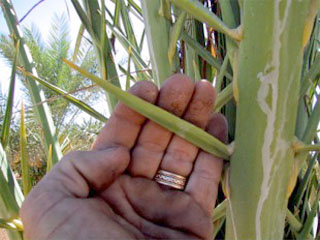
Date Palm Thorn
The palms are visited one last time as thorns need to be removed  to provide safe access for next year's production.


Although high in sugar content, dates are low on the glycemic index.  According to the "Encyclopedia of Healing Foods, ” dates contain beta-D-glucan, a special kind of soluble fiber that’s particularly efficient at reducing high cholesterol levels. This type of fiber also helps control blood sugar levels by slowing the rate at which your small intestine absorbs glucose. 

Honest to goodness, I will never look at my date the same way again!  Not only good looking, he's got a lot more content than I ever gave him credit for.

Err...good thing, as I purchased 12 pounds of them.  Did I mention, they can be frozen?


Saturday, February 14, 2015

On my way over to the date farm, I pass acre upon acre of what is clearly premium, fertile agricultural land.  I learn later, just how fertile this land really is.  A whopping 90% of our nation's leafy vegetables are grown here between the months of November and March.  Because this area has long standing water rights and 350+ days of sunshine each year, Yuma County is the third largest vegetable producer in the United States.


Veggies aren't the only crop they're known for.  Conditions are perfect for Medjool dates, and nowhere else in the world produces more.


As I drive on up, I notice an open air shuttle bus, advertising farm tours.  I step inside the country store and learn they have room for 20 passengers with 19 seats already filled by migrating Canadians.  Wahoo! I'm their "sold out".  
With 20 minutes to kill, I visit the cafe and hear someone ordering a date shake.  I make like a hound dog and follow that order around to the gal in the back who holds the scoop.   With puppy dog eyes, I ask if she wouldn't mind making just a wee bit more for a sample. A minute later I'm raising a spoonful of the date infused goodness to my snout.  Rich and creamy, one spoonful satisfies a wagging tail.


I wander around the store and begin to realize just how much there is to learn about dates.  According to Martha:

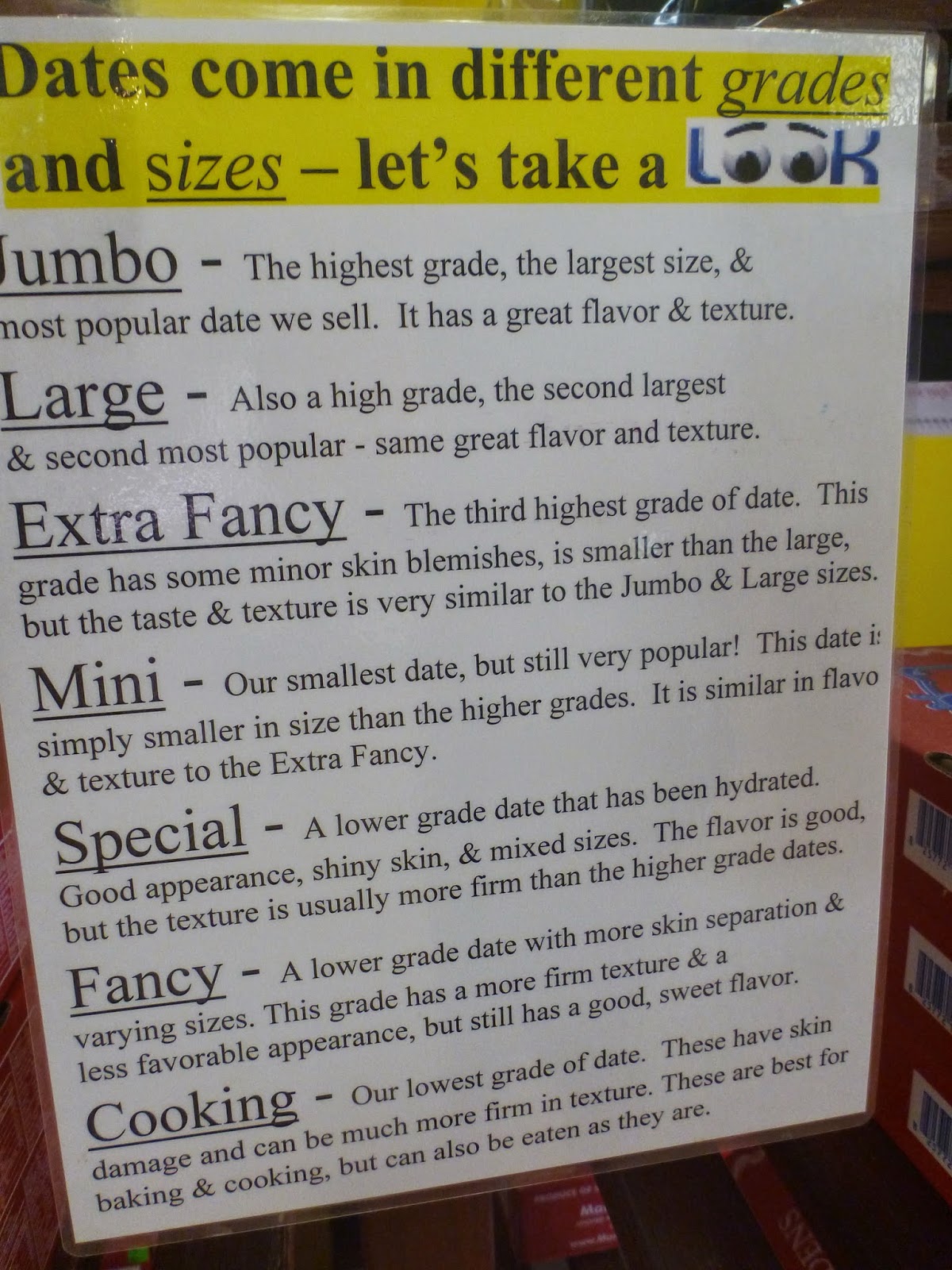
Dates have 7 different levels of grading.  Unlike maple syrup, grading is based upon quality as well as size.

Dates have anti-oxidant levels that are higher than those found in blueberries and pomegranates.

There is more potassium in 5 dates (100 grams) than there is in one large banana.


Jumbos are the Great Dane
in the date world


With my in-class learning just about complete, it's time for field training which is scheduled to last  1.5 hours.  Really?  There's that much to learn about dates?  Yep, and I'll give you the cliff notes version next.


Tuesday, February 10, 2015

While enjoying my Prickly Pear Margarita at El Charro's, I meet a couple and learn about a favorite local's hike in Sabino Canyon, called Seven Falls trail.  I decide to check it out as it's just  25 miles away. 

Before leaving, I read reviews warning visitors to purchase parking passes as citations are regularly issued.  Upon arrival, I stop at the ranger desk to see if my annual park pass covers it.  "Yep, just put it on the dash" I'm told.  Love it! This little piece of plastic saves me coin, unlike all the rest which just spend it.


Seven Falls is an 8 mile r.t. hike with a 650' elevation gain.  My day starts early, as I want to make it to Phoenix this evening, for a dance lesson.

There is an option of cutting off 1.5 miles by taking a shuttle bus to a closer trail head, but why would I want to hurry and pass this up?


This is my second reminder, (first by the ranger) that mountain lions have been spotted in the area.

In addition to pepper spray, which now rests in my palm, I arm myself with the following protocol, should an encounter occur:

Make myself appear as large as possible.
Make noise.
Make eye contact. 
Never run, bend or crouch down.
Slowly create distance.
Fight back, protect the neck and throat.

I'm more vigilant on this hike, scanning the high ledges where they're known to hang out.


Something as simple as removing your sunglasses can make a difference, as a hiker discovered in 2013.  http://tucson.com/news/science/environment/hiker-mountain-lion-survive-close-encounter-on-tucson-trail/article_cf0ab911-8fb6-574a-ab3a-2edf4d22112e.html


Although I never completely forget about the cats, I become more at ease, stowing the pepper spray in my pocket.


It's warming up as the day wears on, having me shed layers as I go.

I'm well into the canyon now having made 5 or so river crossings.  I know I'm getting close.


And then I arrive.  I've seen some beautiful sites on this trip, and this rates among the top.  I stand in awe, marveling at the chiseled pulchritude before me.   
It is simply jaw dropping.


Yes, there are 7 falls.


Saturday, February 7, 2015


I have just enough time to make my way to the raptor viewing area.  Today they will be flying two; the Barn Owl and the Harris's Hawk. 


I'm a bit perplexed as I always thought barn owls were nocturnal.  Captivity perks?


Specializing in rodent prey and catching up to 2,000 mice per year, this owl hunts in the darkest of night relying almost solely on their hearing.  Like most other owls, their ears are asymmetrical on their head - one ear is higher than the other.  This allows the owl to triangulate the sound and catch prey in a 3 dimensional space. 


Harris's Hawk are unique hunters in the raptor world.  They work in pairs and often groups, chasing prey out of cover and into the talons of other members.   Although Harris's Hawk is found in the southern half of Arizona, southwest New Mexico, southern Texas and all through Mexico, and South America, cooperative hunting is only observed in the Sonoran region of their range.


Two to three million years ago the southwestern
landscape was filled with giant land tortoises that
have since gone extinct.
With my top 3 checked off, I am at my leisure to wander around the rest of the property, poking my head into all kinds of nooks and crannies. 


The largest cactus in the world is the candelabro
from the states of Puebla, Oaxaca, and Guerrero, Mexico.


It's rounding 2 o'clock and I stop for a salad at the Ironwood Terraces Restaurant, a casual multi-station food court.  Next door at the tableclothed Ocotillo, I notice a sign advertising Prickly Pear Margaritas. How intriguing!  It's too early for me, but I vow to treat myself to one at the end of the day.


Bighorn Sheep
I continue to learn, explore and experience this outdoor wonderland and now understand why it is a favorite.


It's nearing closing time, so I head back for that Prickly Pear Margarita sunset, only to find the doors closed.  Oh bahh!  This can't be the only restaurant that serves them.  I ask Kitt to find me the best one in town and she tells me they're at El Charro's.  I follow her lead and am there in two shakes of a lamb's tail.


B-ewe-tiful!